Good dairy barn ventilation is about more than moving air. It helps manage heat, humidity, moisture, gases, and stale air while creating a more comfortable environment at cow level.
As barns change, herd sizes increase, and weather patterns create new challenges, a ventilation system that once worked well may no longer provide the consistency the herd needs. That is often when producers begin asking whether they should improve natural ventilation, add mechanical ventilation, or move toward a more integrated system.
There is no single answer for every farm.
The right approach depends on barn design, climate, herd density, orientation, existing equipment, expansion plans, and the conditions cows experience throughout the year. At inBarn, we look at ventilation as part of the complete barn environment rather than as a collection of individual fans.
Our approach to dairy barn ventilation and heat stress solutions starts with one priority: creating consistent conditions that support cow comfort.
What Is Natural Dairy Barn Ventilation?
Natural ventilation uses wind pressure and thermal buoyancy to move air through a barn. Properly designed sidewall openings, curtains, ridge openings, roof geometry, and barn orientation allow fresh outdoor air to enter while warmer, contaminated air exits.
Natural ventilation can be simple and energy efficient when barn design and local conditions support it.
Benefits can include:
- Lower electrical demand for air exchange
- Fewer mechanical components
- Effective air exchange during favourable weather
- Simple operation when openings are properly sized and managed
However, natural ventilation depends heavily on conditions outside the barn.
Wind speed, wind direction, nearby buildings, trees, terrain, seasonal temperatures, and barn orientation can all influence performance. A naturally ventilated barn that works very well on a breezy spring day may behave differently during a hot, still afternoon.
This is why ventilation should be evaluated as part of cow-centric dairy barn design, not treated as an isolated system.
Where Natural Ventilation Can Fall Short
Natural ventilation becomes more challenging when outside conditions do not create enough air movement.
Common concerns include:
- Low wind conditions
- Hot and humid weather
- Obstructions around the barn
- Increased stocking density
- Barn additions that change airflow
- Inadequate inlet or outlet area
- Dead zones around stalls, holding areas, or feeding spaces
Air exchange alone also does not guarantee adequate airspeed at cow level.
During heat stress conditions, cows often need more direct air movement across their bodies. That is where supplemental circulation fans or a more intentionally designed mechanical system may become important.
Farmers considering improvements can start by reviewing how to assess dairy barn ventilation before making changes.
What Is Mechanical Dairy Barn Ventilation?
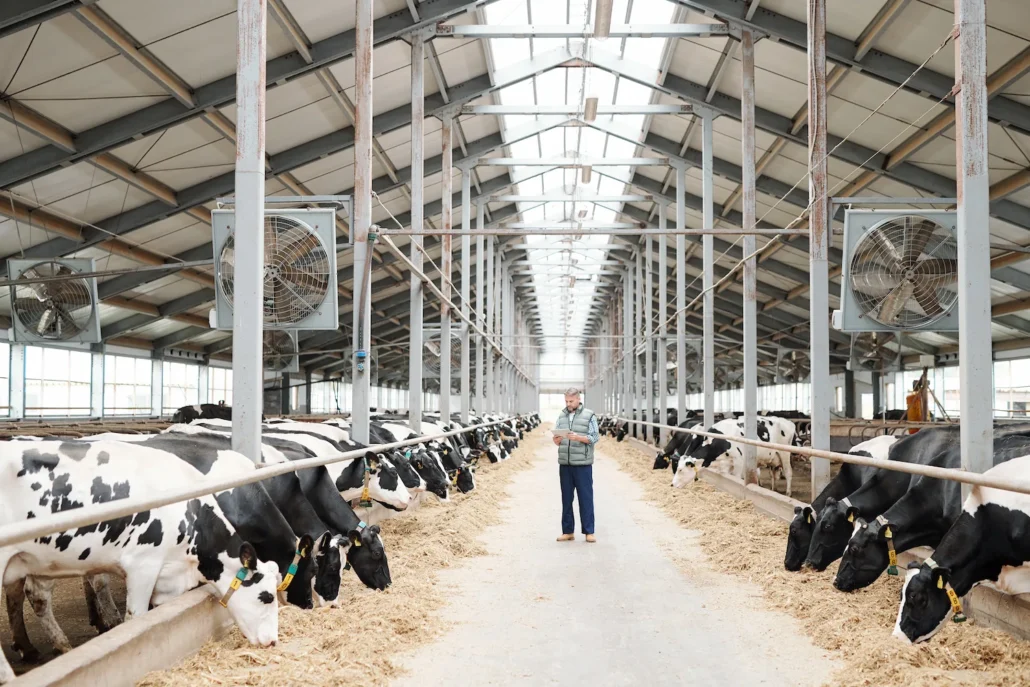
Mechanical ventilation uses fans and controlled openings to create and manage airflow rather than relying primarily on natural wind.
Depending on the barn, mechanical systems can be designed around exhaust fans, positive-pressure systems, cross ventilation, tunnel ventilation, circulation fans, or combinations of these approaches.
The goal is not simply to install more fans. Effective ventilation design considers where air enters, how it travels through the building, what happens at cow level, and where air leaves.
A properly planned mechanical system provides greater control over ventilation performance when natural conditions are limited.
Benefits Of Mechanical Ventilation
Mechanical ventilation can offer several advantages:
- More predictable airflow
- Better control during low-wind periods
- Improved air movement at cow level
- Greater flexibility in challenging barn layouts
- Better integration with automated controls
- More consistent heat stress management
This consistency can be especially valuable in warm climates, high-density barns, enclosed facilities, and barns where natural airflow is restricted.
Modern systems can also use efficient fan technology and variable-speed controls to match ventilation output with actual barn conditions.
Our article on EC motors explains how electronically commutated motor technology can support energy-efficient, controllable ventilation systems.
Natural Vs. Mechanical Ventilation: Which Is Better?
Neither system is automatically better.
A well-designed natural ventilation system can perform extremely well in the right barn and climate. A poorly designed mechanical system can still leave cows with inconsistent airflow.
The decision should be based on what the barn actually needs.
Consider Your Climate
Climate has a major influence on ventilation strategy.
In cooler regions, natural ventilation may provide effective air exchange for much of the year, while carefully positioned fans provide additional airspeed during summer.
In hot climates, reliable mechanical air movement may play a much larger role in heat stress management.
Humidity also matters. Removing heat without managing moisture and air quality can still leave the barn uncomfortable.
Regional conditions should therefore be part of the design from the beginning.
Consider Airspeed At Cow Level
One of the most important distinctions in ventilation planning is the difference between air exchange and cow cooling.
A barn may be exchanging large amounts of air without creating enough velocity where cows are resting, feeding, or waiting.
Fan placement, angle, spacing, mounting height, and performance all influence the air cows actually experience.
We discuss this relationship in more detail in how cow cooling fans support dairy barn airflow and heat stress planning.
Selecting equipment should also be based on actual barn requirements rather than fan diameter alone. Our guide to choosing the right fan for your barn covers several of the factors producers should consider.
When A Hybrid Ventilation Strategy Makes Sense
For many farms, the best answer is not purely natural or purely mechanical ventilation.
A hybrid approach can use natural openings for air exchange while adding strategically positioned fans to improve air movement during warmer or low-wind conditions.
This allows farms to take advantage of favourable natural conditions without depending on them throughout the entire year.
A hybrid system might include:
- Adjustable sidewall curtains
- Properly sized ridge openings
- High-efficiency circulation fans
- Automated fan controls
- Supplemental cooling systems
- Environmental sensors
The important part is making sure each component works as part of one system.
Adding fans without considering inlet air, building pressure, existing airflow paths, or cow location can create unintended dead zones or turbulence.
That is why we recommend evaluating how barn design and ventilation work together for cow comfort before making major changes.
Signs Your Dairy Barn Ventilation May Need An Upgrade
Ventilation problems are not always obvious. Sometimes the first signs appear in cow behaviour or barn conditions.
Watch for:
- Cows bunching in particular areas
- Reduced stall use during hot weather
- Heavy breathing or elevated respiration
- Excess moisture or condensation
- Strong odours
- Flies concentrated in low-airflow areas
- Noticeably warmer sections of the barn
- Uneven fan coverage
- Reduced feeding or resting during heat events
Measurements can provide additional insight.
Air velocity testing, temperature and humidity monitoring, fan performance evaluation, smoke testing, and airflow modelling can help identify what is actually happening throughout the barn.
A ventilation upgrade should begin with diagnosis, not equipment selection.
Plan Ventilation Around The Whole Farm
Ventilation decisions can also affect future development.
If a farm expects to add stalls, expand a milking centre, build another barn, or change cow flow, ventilation should be considered during the planning stage.
Our farm planning process considers barn placement, traffic patterns, ventilation, utilities, workflow, and future growth together.
For farms already considering additional capacity, dairy barn expansion planning can help prevent today’s ventilation solution from creating tomorrow’s limitation.
This long-term perspective is important because airflow can change significantly when new buildings are constructed nearby. An addition can alter wind exposure, create new obstructions, or increase the number of cows generating heat and moisture inside the facility.
Focus On Performance, Not Just Equipment
Upgrading dairy barn ventilation is not simply a question of natural versus mechanical systems.
The better question is: What combination of airflow, air exchange, cooling, controls, and barn design will provide comfortable conditions for the cows in this specific facility?
That answer will differ from farm to farm.
At inBarn, we evaluate the barn, climate, cow environment, existing ventilation, workflow, and long-term plans before recommending a strategy. Whether the solution involves improving natural openings, adding targeted mechanical airflow, incorporating efficient fan technology, or redesigning the complete ventilation system, the objective remains the same: consistent cow comfort supported by practical engineering.
If you are considering a ventilation upgrade, contact us to discuss your barn. We can help evaluate current conditions and develop a ventilation strategy designed around your cows, your climate, and the future of your farm.