
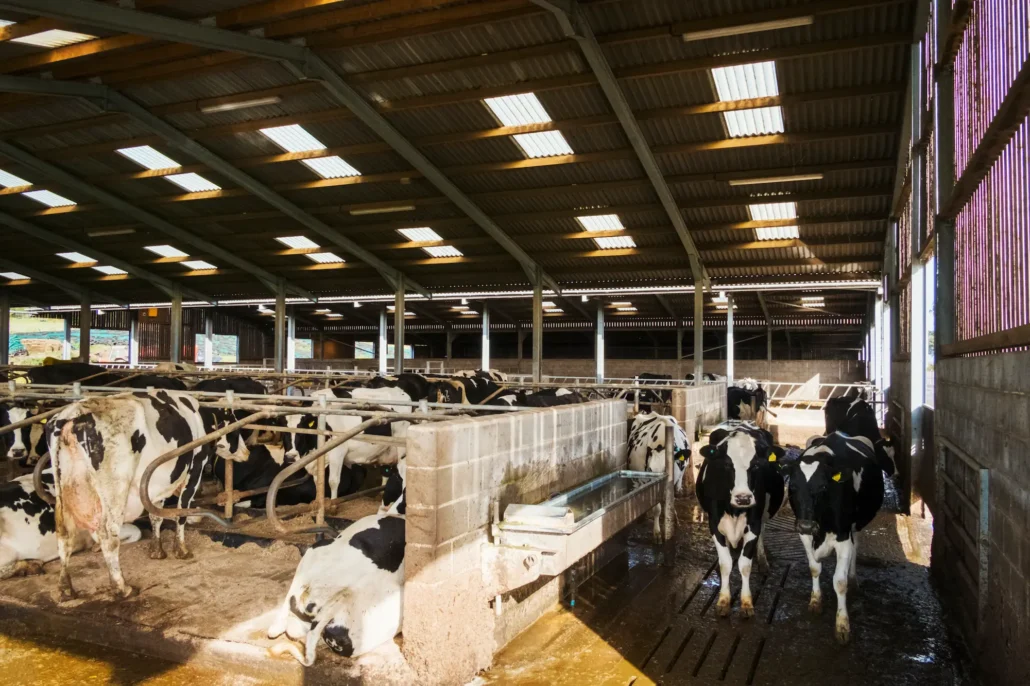
Cow Cooling Starts Where Your Cows Spend Their Time
Cow cooling works best when it starts with your barn, your cows, and the way air already moves through the building.
We look at where cows stand, eat, rest, wait, and move through the day. We also look at how air travels through the barn, where humidity can sit, where stale air can collect, and where heat pressure shows up fastest. A barn can have fans and still have poor airflow where cows need it most.
That is why our dairy barn ventilation and heat stress solutions start with the cow, not the fan count. We design around the building, the climate, the herd, and the way your farm runs, so airflow reaches the places where cows stand, eat, rest, and wait.
Cow cooling fans can be a major part of that plan. They support air movement, cow-level air speed, and heat stress planning when they are matched to the right job. The fan type, spacing, direction, controls, openings, and barn layout all have to work together.
What Do Cow Cooling Fans Actually Do?
Cow cooling fans move air through the barn or within specific barn zones. Depending on the fan type, they can support air exchange, cow-level air speed, and more consistent airflow in the places cows use most.
The first step is knowing what kind of air movement your barn needs.
In our blog on choosing the right fan for your barn, we explain that dairy barn fans come in different sizes, shapes, functions, and materials. Options can include round panel fans, box fans, exhaust fans, high-volume low-speed fans, and basket fans. They’re not all built for the same job.
We separate fans into two main categories: exhaust-style fans and circulation-style fans. Exhaust fans pull or draw air through a space using negative pressure. Circulation fans move air within a required space.
That difference shapes the cooling plan. If the barn needs air pulled through a building, we’re looking at a different design need than moving air across stalls, feed alleys, holding areas, or other cow-level spaces. A fan plan should follow the airflow need, not just the empty space where a fan could fit.
Air Exchange And Air Speed Are Different Jobs
A strong cow cooling plan has to separate air exchange from air speed.
Air exchange is the movement of fresh air into the barn as stale air leaves. It helps remove heat, moisture, and contaminants from the building. Air speed is the movement of air within the barn. For cow cooling, air speed matters when it reaches the cow.
Our Ventilation 101 blog explains why proper ventilation is important for temperature, humidity, and air quality in dairy barns. During hot and humid weather, ventilation helps remove heat and moisture so cows can stay cooler and more comfortable.
That is why we don’t only look at fan count. If air is moving above the cows, it does not automatically mean the resting area, feed alley, or holding area is getting the airflow it needs. Height, spacing, direction, and purpose all matter.
Our ventilation design work studies air movement, humidity, and barn layout so the system fits the facility. We also design natural ventilation systems supported by automated fans and control systems where needed.
Cow Cooling Fans Need A Clear Role
Before we talk about equipment, we need to understand what the barn is asking the system to do.
Is stale air staying in certain areas? Is humidity getting trapped? Are some cow areas getting less useful airflow? Is the holding area too warm? Are fans helping natural airflow, or are they working against it? Are curtains and openings being used in a way that supports the system?
Those are practical questions. They help us connect fan choice to the actual barn conditions.
| Cooling Piece | What It Supports | What We Review |
| Circulation fans | Air movement within barn zones | Cow-level airflow, direction, spacing, and placement |
| Exhaust fans | Pulling air through a space | Openings, pressure, airflow paths, and system balance |
| Natural ventilation | Fresh air movement through the barn | Sidewalls, ridge openings, curtains, roof shape, and climate |
| Automated fans and controls | Temperature and humidity response | Zones, timing, seasonal use, and daily management |
| Evaporative cooling | Added cooling where it fits | Climate, humidity, cow areas, and management style |
| EC motor barn fans | Efficient fan operation | Controls, power use, placement, and system design |
This is where cow cooling becomes more than equipment selection. The barn layout, openings, airflow paths, fan type, and controls all shape what the system can do.
Fan Placement Has To Follow Cow Behaviour
Fan placement should follow the way cows use the barn.
Stalls need attention because cows need comfortable resting conditions. Feed alleys matter because cows spend time eating there. Crossovers and return lanes affect how cows move through the facility. Holding areas also deserve careful planning because heat and humidity can build quickly in high-use spaces.
When we plan airflow, we look at the full facility. The point is not to make one area feel better while another area stays under pressure. We want airflow to reach the places cows actually use.
The physical building matters too. Sidewalls, ridge openings, roof shape, fan spacing, barn width, stocking density, obstructions, cow groups, and local weather all affect the final ventilation plan. Those details change how air moves through the barn.
That is why we don’t treat every fan layout the same. Fans should go where they can support the ventilation plan, the cow areas, and the way the barn operates.
Where Cyclone Fans Fit Into Cow Cooling
Cyclone fans are a useful example of why fan selection has to be specific.
In our Why A Cyclone Fan blog, we explain that Cyclone fans are recirculation fans. They take air already in the barn and blow it back down on the cows, increasing air speed at cow level. That cow-level air speed is critical for cooling cows.
The same blog explains that Cyclone fans use purpose-shaped deflectors at the air discharge point. Those deflectors focus airflow toward individual cows while covering their bodies as they rest in stalls, when the correct fan size and distance are used.
A fan can be well built and still be wrong for a certain space. Clearance, fan size, distance, cow location, airflow target, and control strategy all affect whether the fan is the right fit.
Cyclone fans can also connect with smart barn systems when they use EC motors. In our EC motor content, we connect EC motors with smart barn systems, real-time insights, reduced electric bills, and overall farm operations.
Automated Cooling Needs A Barn Plan Behind It
Automated cooling systems can help ventilation respond to temperature, humidity, zones, and operating needs, but automation still has to be designed around the barn.
In our ventilation design work, we study air movement, humidity, and barn layout to build energy-efficient barn ventilation that reduces heat stress and maintains consistent airflow. We also design natural ventilation systems supported by automated fans and control systems where needed.
Controls should support the way your barn operates through seasonal changes. They also need to work with the fan layout, openings, cow areas, and management needs. When those pieces are connected, the system is easier for your team to understand and operate.
EC motor barn fans and smart barn ventilation systems can help reduce unnecessary power use when they are part of a well-planned design. Good design still comes first because efficient fans need the right placement, airflow paths, and system layout behind them.
A Practical Planning Checklist Before Adding Cow Cooling Fans
Before adding or changing cow cooling fans, we step back and look at the barn as a whole.
1. Start With Cow Areas
Look at the places cows use most: stalls, feed alleys, crossovers, return lanes, and holding areas. If cows spend time there, airflow deserves attention there.
2. Review Fresh Air And Stale Air Paths
Fans need the rest of the barn to support them. Sidewalls, ridge openings, curtains, roof shape, and openings affect how fresh air enters and how stale air leaves.
3. Separate Air Exchange From Air Speed
Your barn can need better fresh air exchange, stronger cow-level air speed, or both. They are connected, but they are not the same design problem.
4. Match The Fan To The Job
Circulation fans, exhaust fans, Cyclone fans, and other fan types all serve different roles. The right choice depends on the airflow need, the cow area, and the physical barn.
5. Plan Around Controls And Seasons
Automated fans and controls can help regulate temperature and humidity, but they should support the way your farm actually operates. Zones, timing, weather patterns, and daily management all affect the plan.
6. Connect Cooling To Future Farm Plans
If you are building, upgrading, or expanding, cooling should be part of the planning conversation. Our farm planning support looks at custom site planning and long-term success, so ventilation decisions can fit where the farm is going.
Quick Glossary For Cow Cooling Planning
A few terms come up often when we talk through cow cooling with dairy producers. Here is how we use them in a barn planning conversation.
Air Exchange
Fresh air replacing stale air in the barn. It helps remove heat, moisture, and contaminants.
Air Speed
Air movement within the barn. For cow cooling, air speed matters most when it reaches cow level.
Circulation Fan
A fan that moves air within a required space.
Exhaust Fan
A fan that pulls or draws air through a space using negative pressure.
Cow-Level Airflow
Air movement that reaches the places where cows stand, eat, rest, and wait.
Heat Stress Planning
Planning around airflow, cooling, humidity, fan placement, controls, and barn layout so the barn is better prepared for warm or humid conditions.
Smart Controls
Controls that help fans and ventilation systems respond to temperature, humidity, zones, and operating needs.
EC Motor Barn Fans
Fans with electronically commutated motors. We connect EC motors with smart barn systems, real-time insights, reduced electric bills, and overall farm operations.
Frequently Asked Questions About Cow Cooling Fans
What Are Cow Cooling Fans?
Cow cooling fans are fans used in dairy barns to move air through the building or within specific barn zones. They can support cow-level air speed, heat stress planning, and more consistent airflow when they are planned properly.
Are Cow Cooling Fans The Same As Ventilation Fans?
They can overlap, but the role matters. Some fans are used for circulation inside a space. Others are used for exhaust, pulling air through the barn. A good ventilation plan looks at the equipment, the building, and the airflow need.
Where Should Cow Cooling Fans Go?
Fan placement depends on the barn layout, cow areas, roof shape, openings, obstructions, weather, and fan type. We focus on the areas cows use most, including stalls, feed alleys, crossovers, return lanes, and holding areas.
Can Automated Fans Help With Heat Stress Planning?
Yes, when the system is designed around the barn. Automated fans and controls can support more consistent operation, but they still need the right airflow plan, fan placement, and zone strategy behind them.
Should Cooling Be Planned During A Barn Expansion?
Yes. When you are planning an expansion, ventilation should be part of the design conversation. Our dairy barn expansion planning work helps connect barn layout, cow comfort, workflow, and long-term planning before the project moves too far ahead.
Build Cow Cooling Around The Full Barn
Cow cooling fans can support better airflow, stronger cow-level air speed, and more practical heat stress planning when they are part of a full barn ventilation plan. Your barn layout, openings, fan type, controls, cow groups, climate, and future plans all affect the final design.
We build cooling and ventilation plans around cows first. We look at the spaces they use, how air moves, and what your team needs to manage the system day to day. That helps us design around cow comfort, air quality, and long-term barn planning.
If you are reviewing your current cooling setup, planning a new barn, or getting ready for an upgrade, contact inBarn and we can talk through the ventilation and heat stress planning that fits your facility.

.svg.png)